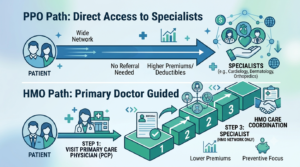
When shopping for individual or family healthcare coverage, choosing between PPO vs HMO private health insurance is one of the most critical decisions you will make. The type of network you select determines not only your monthly premium costs but also which doctors you can see, whether you need specialist referrals, and how much you pay out-of-pocket when receiving care.
For freelancers, small business owners, and families comparing private PPO health insurance plans against low-cost HMO alternatives, understanding the trade-offs between doctor flexibility and monthly savings is essential.
In this comprehensive guide, we will break down PPO vs HMO private health insurance, analyze the pros and cons of each network, explain referral rules, and help you pick the best private health coverage networks for your medical needs and budget.
🎯 [NETWORK COMPARISON ENGINE] PPO Freedom or HMO Savings?
Unsure whether a PPO or HMO fits your lifestyle? Enter your ZIP code to compare real-time doctor networks and monthly premiums from top private carriers in your area.
👉 Compare PPO and HMO Private Health Insurance Rates on InsuranceQuote.cloud
Comparing PPO vs HMO private health insurance networks helps individuals choose between out-of-network flexibility and lower monthly premiums.
💡 What Is the Difference Between PPO and HMO Networks?
At their core, both PPOs and HMOs are managed care plans designed to deliver medical services through designated networks of doctors, hospitals, and healthcare providers. However, their operational rules differ significantly:
What Is a PPO (Preferred Provider Organization)?
Private PPO health insurance plans offer maximum freedom and flexibility. Under a PPO plan, you can visit any doctor, specialist, or hospital without needing a referral from a primary care doctor. Furthermore, PPOs provide out of network private health insurance coverage, meaning you can receive care outside the carrier’s designated network (though at a higher out-of-pocket coinsurance rate).
What Is an HMO (Health Maintenance Organization)?
HMO plans focus on coordinated, localized care to keep monthly premiums low. Under an HMO plan, you must choose a Primary Care Physician (PCP) who oversees all your healthcare services. If you need to see a specialist, you must navigate strict health insurance specialist referral rules to obtain a referral from your PCP first. Except in medical emergencies, HMOs do not cover out-of-network medical care.
📊 Side-by-Side Comparison: PPO vs HMO Private Health Insurance
To help you evaluate HMO vs PPO health insurance pros and cons, review the key operational differences below:
Feature / Coverage Aspect PPO Private Health Insurance Plans HMO Private Health Insurance Plans Out-of-Network Coverage Covered (Higher deductible & coinsurance) Not Covered (100% out-of-pocket except emergencies) Primary Care Doctor (PCP) Not Required Mandatory (Must select an in-network PCP) Specialist Referrals No Referral Needed (Direct appointment access) Required (PCP must issue a formal referral) Monthly Premium Cost Higher Monthly Premium Lower Monthly Premium Out-of-Pocket Deductibles Moderate to High Lower Deductibles & Fixed Copays Claim Filing Requirement May need to file claims for out-of-network care No Claim Forms (In-network providers bill directly) Ideal For Frequent travelers, seniors, complex care needs Budget-conscious individuals staying locally 🎯 [PPO SPECIALIST ACCESS BOX] Skip the Referral Waiting Times
Want direct access to medical specialists without waiting weeks for PCP referrals? Explore top-rated private PPO health insurance plans today.
👉 Find Broad-Network PPO Private Plans on InsuranceQuote.cloud
Analyzing HMO vs PPO health insurance pros and cons highlights the choice between direct specialist access and lower deductibles.